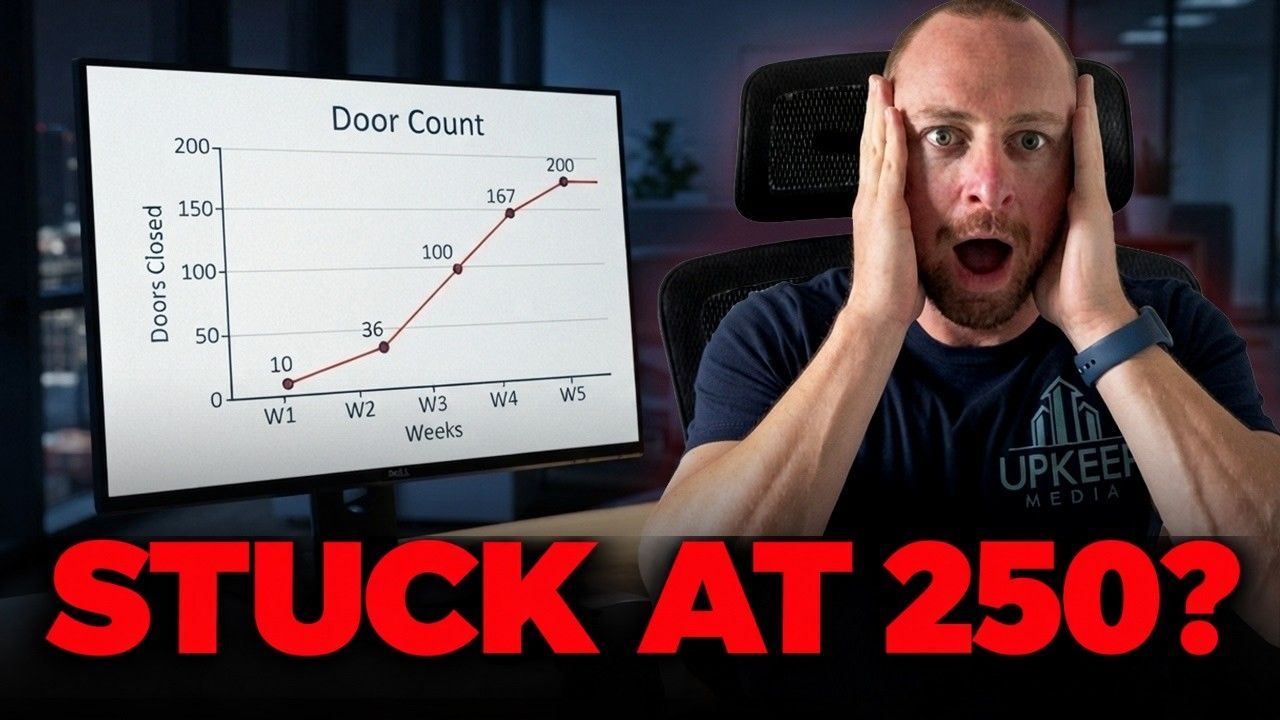

How To Get Unstuck at 250 Doors: The 4 Causes of a Property Management Growth Plateau
Stephen FoxA property management growth plateau happens when the doors you add each month equal the doors you lose. Owner churn near 1.7% a month grows with your portfolio, so flat usually turns into decline. The four causes are churn you outgrew, a referral channel that hit its ceiling, starting a second channel too late, and capacity or margin problems marketing can't fix.
Key takeaways
- Multiply the doors you add in an average month by 60 to estimate your plateau: four a month stalls near 240 doors and six a month near 360, assuming owners stay about five years.
- With owners staying about five years, a property management company loses roughly 1.7% of its doors every month, so losses grow with the portfolio while new doors grow only with effort.
- Referrals close at 70% to 90% and cost nothing, yet their volume is capped by the size of the realtor network and by transaction volume, so doubling effort won't double output.
- Start a second owner acquisition channel while referrals still work, because new channels take months or years to produce owner leads and operators who start under pressure often quit around month four.
- If under 30% of your new owners come from a source you control, channel dependency is the likely cause of your plateau.
The numbers
- about 5 years: How long an owner often stays with a property manager, the rule of thumb used in our episode.
- about 1.7%: The share of total doors a company loses each month when owners stay about five years (60 months).
- 60: The multiplier for the plateau estimate: average doors added per month times 60.
- around 240: The door count where a company adding four doors a month plateaus, per the episode's formula.
- roughly 360: The door count where a company adding six doors a month plateaus, per the episode's formula.
- 18 months: How long a slow decline looks exactly like a plateau before operators notice, per our episode.
- 70%, 80%, sometimes 90%: The close rate on referral leads cited in our episode.
- 100 to 300 doors: The company size where a single channel hitting its ceiling is the most common cause, per our episode.
- about $110 per month: The example used in our episode for both revenue per door and the cost to service that door, a margin of zero.
- under 30%: The share of new owners from a source you control below which the episode names channel dependency as the cause.
Watch the full video
What we cover in the video
- 0:00 Busier than ever but the door count is flat. Why an operator who signs more owners than ever, with a bigger team working harder, can still see the door count stay flat.
- 0:26 Why a plateau is not a pause. How a plateau is the point where doors coming in match doors going out, and why a slow decline looks like a plateau for the first 18 months.
- 1:46 Cause 1: The churn you grew into. The churn math: owners staying about five years means losing about 1.7% of doors a month, and multiplying monthly additions by 60 gives your plateau number.
- 3:13 About Upkeep Media. A short break on the free session at upkeepmedia.com/growth, where the team reviews what competitors in your market are doing and where your company stands online.
- 3:52 Cause 2: Your one channel hit its ceiling. Why referrals close at 70% to 90% yet cap growth for companies between 100 and 300 doors, told through an operator at around 150 doors who depended on realtors.
- 6:20 Cause 3: You waited until it broke. Why building a second channel only after the first breaks leads operators to quit around month four of a ramp that needs longer.
- 8:37 Cause 4: When marketing is not the problem. How onboarding capacity limits and a margin where a door earns about $110 and costs about $110 make pricing, not marketing, the first fix.
- 9:43 The pushback: referrals are my best leads. The answer to operators who say referrals are their best leads: keep every one, and treat referrals as a multiplier on a pipeline you own.
- 10:22 The three-number diagnostic. Three numbers to work out in 10 minutes, and why under 30% of new owners from a source you control points to channel dependency.
You've signed more owners this year than in any year before. The team is bigger than it was two years ago, and everyone is working harder.
The door count hasn't moved.
We see four causes behind that plateau, and on most calls we can tell which one an operator has inside the first 10 minutes.
Three of the four are about owner acquisition. The fourth has nothing to do with marketing, and more lead flow can make it worse.
Why Has My Property Management Company Stopped Growing?
A property management company stops growing when the doors it adds each month equal the doors it loses. That balance is unstable. Lost doors scale with portfolio size because the churn percentage stays the same, while new doors grow only when you push acquisition harder, so a flat year is usually the year before a decline.
A plateau feels like a pause.
The arithmetic points the other way. Every owner you sign this year raises the number of doors you'll lose next year, even when retention stays exactly as good as it's always been, because the 1.7% that leaves each month holds constant while the base it applies to keeps growing.
That's how a company signs more owners than ever and still holds flat. Each new door replaces one that left.
Most operators miss the turn. For roughly the first 18 months, a slow decline looks exactly like a plateau.
How Many Doors Does a Property Management Company Lose to Owner Churn?
A property management company whose owners stay about five years loses roughly 1.7% of its doors every month, because five years is 60 months. At 80 doors that's about one door a month and nobody notices. At 240 doors the same rate takes about four, which is everything a company adding four a month brings in.
Owner churn is the share of owners who end their management agreement over a given period. Our episode uses a rule of thumb for it: an owner often stays with a property manager for about five years.
How Do You Calculate Your Plateau Number?
Take the number of doors you add in an average month and multiply it by 60. The result is roughly the door count where your company will stall if nothing about acquisition changes.
- Adding four doors a month points to a plateau around 240 doors.
- Adding six doors a month points to roughly 360.
Both figures assume a five-year owner tenure, so run the same math on your own tenure data for your exact number.
If the result lands close to your current door count, your acquisition rate explains the plateau by itself.
What Changed Between 80 Doors and 250?
At 80 doors you lost about one a month and never noticed. Signing three a month felt like flying.
The system that took the company from 80 doors was built to grow from 80. Holding 250 takes a bigger one.
Keeping owners longer shrinks the number you have to replace, and our guide on how to prevent owner churn covers that side. The rest of this post stays on acquisition.
Are Realtor Referrals Enough to Keep Growing a Property Management Company?
Realtor referrals are the best leads a property management company gets, and they still make a weak engine for growth. Referral volume depends on how many transactions those realtors close and on the size of the network, so rising rates or a small market can shrink your pipeline without you doing anything wrong.
We see this cause most often among companies managing between 100 and 300 doors, and the one channel is almost always referrals.
Referrals deserve their reputation. They close at 70%, 80%, sometimes 90%, they cost nothing, and they onboard more easily because someone the owner already trusts said you're good.
The weakness is ownership. A referral pipeline is someone else's channel that you're borrowing. Rates go up, transactions drop, and your pipeline drops with them. A sister brokerage, a partner company or your own sales side has the same structure under a nicer name.
We had a call with an operator at around 150 doors: good business, years in the market, a strong reputation. Every owner he'd ever signed had come through realtor relationships. Some months brought a few owners. Some brought none.
Why Does Referral Volume Hit a Ceiling?
Referral volume is capped by the size of the network. Your market has a limited number of realtors, and they work with a limited number of clients who own rentals, so doubling your effort with that network won't double the output.
The close rate hides it. When 80% of the owners you speak with sign, the numbers look fantastic right up until volume drops and there's nobody left to close.
| Factor | Referral pipeline | Channel you control |
|---|---|---|
| Close rate | 70% to 90%, per the episode | Lower than referrals |
| Cost | Nothing | Spend and effort to build |
| Who sets the volume | Realtors, partners, transaction counts | You |
| What caps volume | Size of the referral network | How much you build and invest |
| Time to produce owner leads | Already running | Months, sometimes years |
What About "Referrals Are My Best Leads"?
That pushback comes up every time, and the operator is right. Keep every referral, ask for more and encourage them.
Referrals still can't be the engine, because you don't control the throttle. They multiply a pipeline you already own. As the episode puts it, "A great multiplier on zero is still zero."
When Should You Start a Second Owner Acquisition Channel?
Start a second owner acquisition channel while your first channel is still working. A new channel takes months, sometimes years, to produce meaningful owner leads, and operators who start after referrals dry up tend to spend under pressure, judge results weekly, and quit before the channel has had time to ramp.
Almost every operator we speak with starts the second channel the moment the first one stops working. It sounds rational. It's the worst possible timing.
Channels ramp slowly by nature. It takes time for someone you met at a networking event to think of you when they meet a rental owner, for content to index, for property management SEO rankings to move, and for enough owners in your market to have seen you more than once.
What Does Starting Late Cost?
Start in January while referrals are still fine, and you spend money you didn't strictly need. By September you have a steady flow of property management leads from a second source, so when referrals dry up that month, you have somewhere else to turn.
Start in September because referrals have stalled, and you're spending under pressure, checking every dollar and watching weekly results on something that structurally can't produce until the following June.
Month four is where it breaks. Leads haven't clicked, nerves set in, and the operator pulls the plug about two months before the work would have started delivering. A year later, the story is that marketing didn't work. The episode's answer: "You tried 4 months of a 6-month process."
Starting early may cost a few months of spend. Starting late can cost a year of flat or declining revenue.
Owned channels compound slowly. Service Star Realty in Phoenix, AZ added 350 new doors under management in 36 months through SEO with Upkeep Media, and organic search became the source of more than 50% of its leads.
What If a Property Management Growth Plateau Isn't a Marketing Problem?
A property management growth plateau is sometimes caused by capacity or margin, and in those cases more marketing can make the situation worse. Capacity shows up as slower proposals, missed follow-ups, and delayed onboarding. Margin shows up when revenue per door roughly equals the cost to service it, so every new door adds work without adding profit.
Nobody announces a capacity limit. It arrives one late proposal and one delayed onboarding at a time.
Margin creeps in the same way. If your average door brings in about $110 a month and costs about $110 a month to service, the company makes no money on it. Operators in that spot stop pushing for growth without saying why, and they're right to, because growth at a broken margin only buys a bigger version of the same problem.
Fix pricing first. Then go after doors.
How Do You Find Which Cause Is Yours?
Three numbers identify which cause is behind a property management growth plateau, and working them out takes about 10 minutes: owners signed last month, owners lost last month, and the percentage of new owners who came from a source you control. If that third number is under 30%, channel dependency is your main problem.
- Count the owners you signed last month. Most operators we speak with know this instantly.
- Count the owners you lost last month. Most guess. Write down the real figure.
- Calculate the share of last month's new owners who came from a source you control. Most have never calculated it.
- Multiply your average monthly door additions by 60 and compare the result with your current door count. A close match points to churn you grew into.
- Compare your best and worst months over the last two years. A big gap you can't explain means someone else owns your pipeline.
- Check proposal speed, follow-ups and margin per door before adding marketing spend. Trouble there points to a capacity or margin problem.
If referrals are still flowing and step three comes back under 30%, you still have time to build the second channel before you need it.
Frequently Asked Questions
How long do owners typically stay with a property management company?
An owner often stays with a property manager for about five years, which is the rule of thumb our episode uses. At that tenure, a company loses roughly 1.7% of its doors each month. Your own numbers may differ, so pull the real average from your records before running the plateau math.
Is it worth investing in marketing when referrals are still working?
Often, yes, because a new channel tends to need months or years to produce owner leads. Starting while referrals still flow may cost a few months of spend you didn't strictly need. Starting after they dry up can cost a year of flat or declining revenue.
How long does a new owner acquisition channel take to produce leads?
A new owner acquisition channel usually takes months, sometimes years, to produce significant owner leads. Content has to index, rankings have to move, a video library has to build, and owners in your market have to see you more than once. No channel comes with a guaranteed timeline.
What counts as a lead source I control?
A lead source you control is one where you set the volume, such as your website, search rankings, content or a video library. Realtor referrals, a sister brokerage, a partner company and your own sales side all depend on someone else's transaction volume, so they sit outside that count.
Why does a high referral close rate hide a growth problem?
A referral close rate of 70% to 90% makes every conversation look productive, so the real constraint, volume, goes unnoticed. When 80% of the owners you speak with sign, the pipeline looks healthy right up until realtor volume drops and there's nobody left to close.
Can more marketing make a plateau worse?
More marketing can make a plateau worse when the cause is capacity or margin. If proposals already go out slowly and onboarding is delayed, more leads simply get dropped. If a door earns about what it costs to service, as in the $110 example, each new door adds work without profit.
What's the difference between a plateau and a decline?
A plateau is the point where doors added equal doors lost, and a decline begins when losses pass additions. The two look identical for roughly the first 18 months, because churn grows with the portfolio while new doors only grow when you push acquisition harder.
How fast can a property management company get unstuck?
There's no fixed timeline, and any channel you build tends to need months before it produces owners. The fastest step is diagnosis: owners signed, owners lost and the controlled-source share take about 10 minutes to work out. Which cause you find decides what the fix looks like and how long it may take.
Final Thoughts
A flat door count tends to feel like bad luck. Usually it's three numbers you can work out in 10 minutes.
Start with the controlled-source share. If it sits under 30% while referrals are still coming in, you're at the cheapest point you'll get to build a second channel.
Our free growth session at upkeepmedia.com/growth walks through what competitors in your market are doing to bring on new properties and where your company is positioned online.
About Author
Former CPA at Ernst & Young who traded spreadsheets for strategy. Stephen co-founded Upkeep Media in 2015 with a vision to build the most specialized property management marketing agency in North America. His financial acumen and competitive drive have been the foundation of Upkeep's growth.
Newsletter
Get Weekly PM
Marketing Tips
Join 5,000+ property management professionals who get our weekly marketing insights delivered to their inbox.
Popular Posts

The Property Management Growth Playbook
Newsletter
Get Weekly PM
Marketing Tips
Join 5,000+ property management professionals who get our weekly marketing insights delivered to their inbox.
The Property Management Growth Playbook
Blogs
Read More Blogs



Newsletter
Get Weekly PM
Marketing Tips
Join 5,000+ property management professionals who get our weekly marketing insights delivered to their inbox.
Newsletter
Never Miss a PM Marketing Insight
Join 5,000+ property management professionals who get our weekly marketing insights delivered to their inbox.