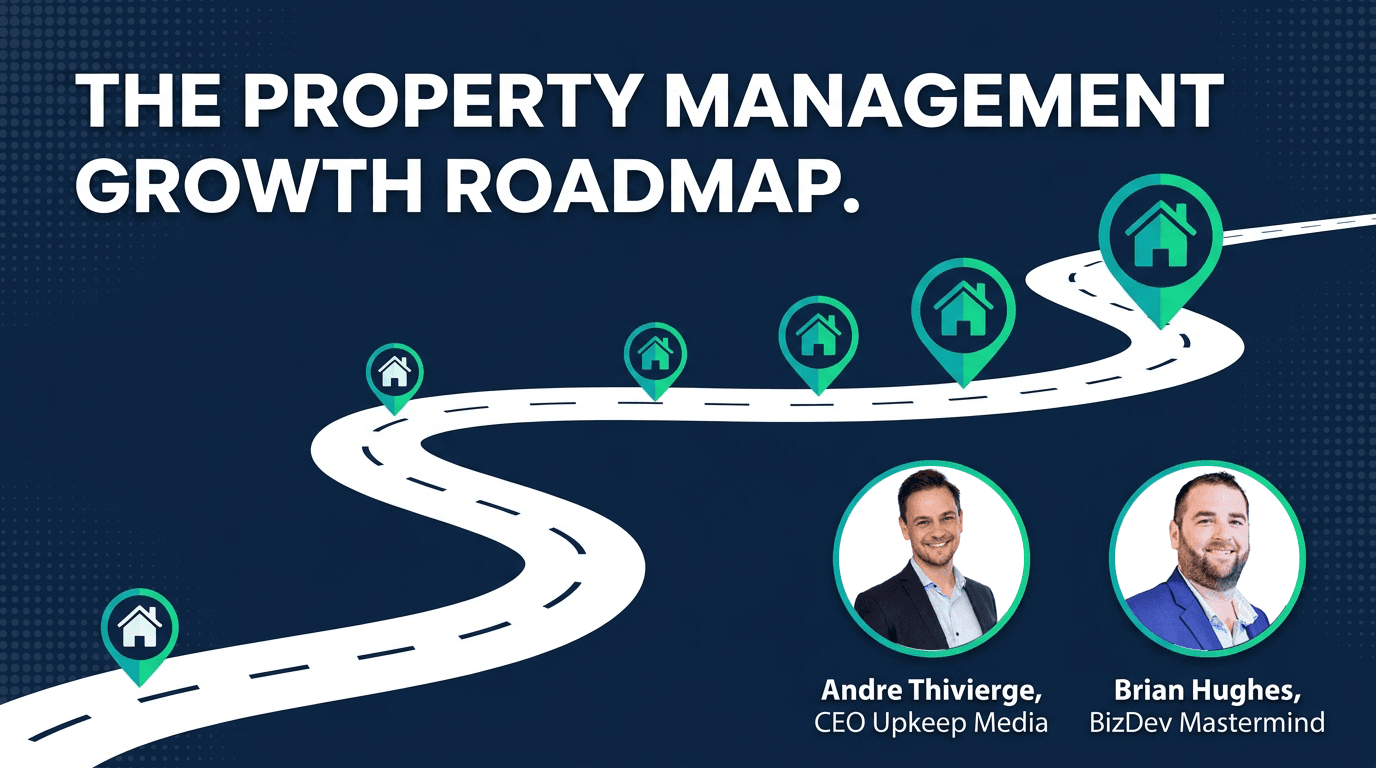

The 2026 Roadmap to More Owner Leads
Andre ThiviergeProperty management companies get more owner leads in 2026 by fixing the foundation first (a rating above 4.0, churn near 10 to 15%, a CRM). Next, they show up in both Google and AI answers with city pages and published operating numbers. Finally, they run a repeatable realtor and partner referral process. AI-referred leads are small in volume but convert best.
Key takeaways
- The number one Google result has fallen from about 7 clicks per 100 searches to about 1.6 as AI answers settle questions before anyone scrolls.
- In our study of 31 property management companies, AI search produced 1.6% of owner leads but converted at about 3.7%, better than Google, referrals, direct or paid.
- Publishing your own operating numbers, such as days to lease, occupancy and renewal rates with a last-updated date, can earn 50 to 100 times more AI citations than generic blog content.
- ChatGPT pulls local data from Yelp and Bing as well as Google, so matching your name, address and phone number across all three may be the cheapest AI win available.
- Only about 15% of emails get read, so realtor outreach starts with a phone call, and in the episode's example a list of 200 investor-focused agents narrows to 20 to 40 real referral partners.
Watch the full video
What we cover in the video
- 0:00 Welcome and how this roadmap works. The hosts introduce themselves, one from 25 years in performance marketing and the other from business development in property management, and explain the roadmap format.
- 3:22 Fix these before you spend a dollar on growth. The foundations to fix before investing in growth: a professional website with a free rental estimate, an About Us page, a rating above 4.0, churn near 10 to 15%, a CRM and a clear owner of business development.
- 8:41 Why Google clicks are dropping and where they go. Why AI answers are cutting Google clicks by up to 61% on some searches, with the number one result falling from about 7 clicks per 100 to about 1.6, and which page types are still gaining traffic.
- 15:03 The one SEO metric worth tracking in 2026. Why branded search, converting at 40 to 70%, is the metric to track, and the website, Google Business Profile and review signals that Google and AI engines both read.
- 17:09 Building a realtor referral list that actually converts. A step-by-step realtor referral process: what to offer agents, building a list from MLS multifamily sales, LoopNet and Crexi, calling first, and nurturing a shortlist through a CRM workflow.
- 26:31 Facebook groups, BiggerPockets, and LinkedIn for BDMs. How BDMs find owners and referral sources in local Facebook investor groups, on the BiggerPockets investor map and by connecting with every lead on LinkedIn.
- 28:21 How property management companies get cited by AI. A 31-company study of owner lead sources, why AI leads convert at about 3.7%, the FLIP framework, and why first-party data and Yelp and Bing listings drive AI citations.
- 36:25 Five moves to make this quarter. Five moves for the quarter: city pages, published operating numbers, matching Google, Yelp and Bing profiles, cost comparison content and one calculator, plus why llms.txt files don't matter.
- 39:24 Audience questions on referral lead data. The hosts answer an audience question about referral lead share and why younger companies tend to lean more on referrals.
- 40:12 Partnering with lenders, title, insurance, and CPAs. How to form win-win partnerships with investor-focused lenders, title companies, insurance agents and CPAs by positioning the property manager as the gatekeeper to rental owners.
- 46:20 Brokerage presentations, networking, and sponsorships. How to book brokerage presentations, work networking events with photos for social content, and use sponsored events to meet key players.
- 48:49 Why speed to lead decides who wins the deal. Why responding to an owner lead within five minutes makes a company about eight times more likely to qualify it.
- 50:14 A preview of Upkeep's new Homebase platform. A preview of Upkeep's Homebase client portal, including the growth report, AI search traffic tracking, visitor intelligence and a pilot tool for finding self-listing owners.
- 55:41 What separates a BDM who succeeds from one who fizzles. Where to recruit BDMs, why the first 90 days decide whether they stay, and how weekly activity KPIs and monthly production reviews catch problems early.
- 58:30 The action list and where to start. The closing action list: publish real numbers with dates, claim Yelp and Bing, track branded search monthly, and the free reports offered to attendees.
Before property management, I spent 25 years at one performance marketing agency. The same mistake showed up in every industry we touched: companies buy growth before they fix the thing that leaks it.
Our 2026 roadmap episode opened on exactly that point. Our guest, who has spent years training business development managers (BDMs) for property management companies, called it pouring water into a leaky bucket.
So this post follows the order we taught it in. Foundation first. Then how owners find you now, which includes ChatGPT and Google's AI answers. Then the sales plays that still add doors every month.
What Should a Property Management Company Fix Before Investing in Growth?
A property management company should have five things in place before hiring a BDM or raising its marketing budget: a professional website with a free rental estimate, a Google rating above 4.0, annual churn in the 10 to 15% range, a CRM, and one named person responsible for business development. Without them, new doors tend to leave as fast as they arrive.
The rental estimate comes first because of how owners call. As our guest put it on the episode, "nine times out of 10 when someone calls into your property management business, they have two questions." What will my home rent for, and what do you charge?
A free rental estimate answers the first one before the phone rings.
The About Us page deserves more work than most operators give it. An owner handing a property to a manager from another state, or another country, wants to see the team and know it's local.
Churn is the one I'd underline. If you're losing 25% of your portfolio a year for reasons unrelated to sales, a BDM who signs 100 or 200 units a year just speeds up the revolving door.
The CRM pays off even at a few leads a month. A company that has logged leads for close to a decade has a list it can return to for years.
Then decide who drives the engine. Some owners have the capacity to do business development themselves until revenue supports a hire. Other companies see steady door growth the moment one person gets that single focus. Either way, match expectations to hours: a couple of hours a week rarely brings in 20 or 30 units a month.
Why Are Google Clicks Dropping for Property Management Companies?
Google clicks are dropping because AI answers now sit above many search results and settle the question before anyone scrolls. In the figures I walked through on the episode, clicks have fallen by up to 61% on some searches, and the number one organic result has gone from about 7 clicks per 100 searches to about 1.6.
Google AI Overviews are the generated summaries Google places above the regular results, and Google's AI Mode turns the whole search into a conversational answer.
None of this means Google is fading. Google handles about 14 billion searches a day against roughly 37.5 million ChatGPT prompts, and 99.8% of ChatGPT users also use Google. Owners research you in ChatGPT, check you on Google, then call.
What's changing is who gets the click. About 83% of AI searches end without one, which is what zero-click search means.
The content losing clicks is the content AI can answer for you: FAQs, general statistics, definitions. The content gaining is what AI can't replace. Tools and calculators are up about 500%, and contact, service and local pages are climbing too.
Property management sits on that second side. It's local, transactional and high intent. Most sites just haven't been built to show it yet.
What Is Branded Search and Why Does It Matter in 2026?
Branded search is the number of people who type your company's name into Google instead of a generic phrase like "property manager in Boise." Branded search is the SEO metric I'd track above all others in 2026, because no AI answer sits between the searcher and your listing, and those searches convert at 40 to 70%.
Search the generic phrase and an AI answer usually appears before anyone clicks. Search a company's name and it doesn't, because the owner already knows who they want. Everything else in this post exists to grow that one number, so check it every month.
Google and AI engines read the same three things when they decide what they know about you.
Your website
Above the fold: the outcome in one line, proof numbers, a named client result and a clear call to action. Add a real team page and real reviews. That's what a crawler reads first.
Your Google Business Profile
Fill every field: category, services, weekly posts, photos. The profile feeds the map pack and Gemini's answers. Our guide to Google Business Profile optimization for property managers covers the fields in order.
A review engine
Send the Google review link after every onboarding and whenever an owner is happy. Volume, recency and your replies all count, and every review becomes something an AI answer can cite.
Do AI-Referred Owner Leads Actually Convert?
AI-referred owner leads convert better than any other channel we measured. In a study we ran of 31 property management companies, AI search produced only 1.6% of owner leads, yet our analysis put its conversion rate at about 3.7%, ahead of Google, referrals, direct traffic and paid. An owner who arrives from an AI recommendation has usually already decided.
Here's the full split from that study:
| Lead source | Share of owner leads | What the episode showed |
|---|---|---|
| Google Search and Map Pack | 54% | Still doing the heavy lifting |
| Direct and maps | About 34% | Second largest source |
| Referrals | About 6% | Often a bigger share for younger companies |
| Paid | About 4% | Google Ads catches owners actively searching; Meta reaches owners who don't know they need a manager yet |
| AI search | 1.6% | Converts at about 3.7%, the highest of any source |
1.6% looks like a rounding error. I said as much to the audience before showing the conversion rate. Google sends you a browser; AI sends you a believer.
The reporting also undercounts AI. Many owners read an AI answer, see a name, then go to Google and search for it. That visit lands in your analytics as branded or direct traffic, so you're likely getting more AI-driven business than your reports show.
How Do Property Management Companies Get Cited by ChatGPT and Google AI?
Property management companies get cited by publishing information AI engines can't answer from memory: local, current, detailed and specific to their own operation. We call that framework FLIP, for freshness, local intent, in-depth content and personalization. Property management questions tend to hit all four, which pushes the engine to pull and cite live pages.
Generative engine optimization (GEO) is the work of getting a company named and cited in answers from ChatGPT, Gemini, Claude and Google's AI Mode. Rent levels and regulations change constantly. A model doesn't hold Boise in memory in any detail. Your fees and contract terms exist only on your site.
Publish your own numbers
In our analysis of 22 million AI queries, first-party data earned 50 to 100 times more citations. Every property management site has the standard blog posts, and AI already knows most of what they say. It can't know your eviction rate in Boise or how you screen applicants. To use that, it has to cite you by name.
Earn mentions on pages you don't own
This one surprised me. About 85% of AI brand mentions come from other sites, leaving your own site roughly 15% of the picture. Almost half of AI citations come from places like forums. YouTube, review sites, directory listings and a NARPM presence all count now.
Fix Yelp and Bing
When I asked the live audience who had an updated Yelp and Bing listing, nobody typed yes. ChatGPT pulls local data from Yelp and Bing as well as Google, and in smaller markets it can get confused and hand leads to a bigger city's competitors. Where Google shows 14 companies, an AI answer might name seven. You can have 500 Google reviews and still struggle to appear in ChatGPT.
You'll also hear that you need an llms.txt file or content chopped up for robots. Google's own Search Central guidance says its AI features don't need that, and nothing we've seen contradicts it. We run the full GEO and SEO playbook for clients through our AI visibility program.
What Five Moves Should You Make This Quarter?
The five moves that matter most this quarter are rebuilding city pages, publishing operating numbers with a last-updated date, matching Google, Yelp and Bing profiles, adding cost comparison and pricing content, and shipping one on-site calculator. Each move gives Google and AI engines something local, fresh or first-party that they can't produce themselves.
- Rebuild your city pages. Create one real local page per main city, with a map on it. A single "areas we serve" page isn't enough anymore.
- Publish your own numbers. Post occupancy, days to lease, eviction and renewal rates, each with a last-updated date. The date is what signals freshness.
- Fix the triangle. Claim Google, Yelp and Bing, and make the name, address and phone number match exactly on all three. A discrepancy looks fishy to Google.
- Add cost comparison content. Write self-managing versus hiring a property manager in your city, and build a real pricing page. AI can't state your prices on your behalf.
- Ship one tool. Add a rent versus sell calculator or a fee calculator. AI can't run that calculation for an owner.
To see where you stand before you start, run the free AI visibility report.
How Do You Build a Realtor Referral Pipeline?
A realtor referral pipeline starts with a targeted list of agents who work with investors, then a short qualifying phone call, then months of varied touch points tracked in a CRM, and finally a meeting or a slot at a brokerage sales meeting. Our guest was firm that the list comes before any outreach.
- Know what you offer. Accurate rental estimates, an opinion on a property a client is buying, a spot in your owner newsletter for listings that would make good rentals, and education such as a webinar on building a pro forma. A shared listing that sells to one of your clients is another door to manage.
- Build the list. Pull MLS records for agents who sold multifamily, the way you'd spot an agent who closed 10 duplexes last year. Check LoopNet and Crexi for agents listing small apartment buildings. Ask every new client which agent helped them buy. In high-cost markets like San Diego or Seattle, look for volume instead.
- Call before you email. Only about 15% of emails get read, according to the figure shared on the episode. Keep the first call short and about qualifying: who do they refer property management to now, and how often do their clients need it?
- Shortlist. In the episode's example, 200 agents narrow to 20 to 40 who genuinely fit.
- Grow the relationship. Connect on social media, leave an honest review of your conversation, send a calculator or checklist they can share, and invite them to an event. Set it up as a workflow in your CRM so no step depends on memory.
- Get in the room. "Real estate is still very much a handshake business," as the episode put it. Brokerages that hold monthly or quarterly sales meetings are the best room to get into.
One BDM in San Antonio followed this path almost exactly: a shortlist of 10 brokerages with heavy multifamily sales, cookies at the front desk, follow-up, a meeting with the broker, then a speaking slot at the next sales meeting.
Which Other Partners Refer Rental Property Owners?
Lenders, title companies, insurance agents, CPAs, attorneys, contractors and new home sales consultants all refer rental property owners, because property managers control access to a group they want to reach. A company managing 300 properties represents a few hundred owners, which makes the property manager the gatekeeper in any partnership conversation.
Look for the investor-focused version of each: the investor-friendly title company, the CPA who works with real estate investors. Insurance agents are a strong fit because nearly every new or accidental landlord needs to update coverage.
The partnership formats are simple. A joint email to your owners about financing their next purchase. Co-branded social posts, which also become the off-site mentions AI engines cite. Sponsoring a title company's lunch and learn, sometimes for the price of a fruit tray. Keep partners in your own local market.
At every event, take photos. The episode was blunt: "If your BDMs are going to an event not getting pictures, tell them it doesn't count."
Online, the same logic applies in local Facebook investor groups, on BiggerPockets, where the homepage map shows investors with 10 to 30 units in a market, and on LinkedIn, where every lead and every realtor you meet should become a connection.
How Fast Should You Respond to a New Owner Lead?
A new owner lead should get a response within five minutes. Speed to lead is the time between an inquiry arriving and a real response reaching the owner, and responding within five minutes makes a company about eight times more likely to qualify that lead than waiting an hour or a day.
Visibility is worthless if the lead dies in a voicemail box.
The same discipline applies to the BDM chasing those leads. A new BDM needs visible traction in the first 90 days or they'll likely start looking elsewhere. Review activity weekly: calls, meetings, social posts. Review production monthly. Decide in advance what happens when it isn't working, because "just over the hump" thinking keeps a struggling BDM on far too long.
Final Thoughts
I told the audience that the news for property management is better than in almost any industry I've worked in. Owners ask local, current, specific questions, and those are exactly the questions AI engines have to look up.
The companies AI recommends in 2027 are being written into the data right now.
Upkeep Media runs this work for clients, but the first moves don't need an agency. Claim Yelp and Bing this week. Put one real operating number on your homepage with a date on it. Start tracking branded search monthly.
If you'd rather have a plan built around your own market and competitors, get your free growth plan.
About Author
Andre brings almost 30 years of experience building and scaling performance marketing operations and technology platforms. He was employee #1 at DFO Global, helping grow the performance marketing agency to more than 300 employees, and later served as COO at Inflektion AI. Andre joined Upkeep in 2026 with a clear mission: to transform the company into a product-enabled growth engine for the property management industry, pairing the team's marketing expertise with technology and AI that help clients add more doors, faster. He leads with a belief that the best results come from strong partnerships, honest communication, and a team that is empowered to do its best work.
Newsletter
Get Weekly PM
Marketing Tips
Join 5,000+ property management professionals who get our weekly marketing insights delivered to their inbox.
Popular Posts
The Property Management Growth Playbook
Newsletter
Get Weekly PM
Marketing Tips
Join 5,000+ property management professionals who get our weekly marketing insights delivered to their inbox.
The Property Management Growth Playbook
Blogs
Read More Blogs


Newsletter
Get Weekly PM
Marketing Tips
Join 5,000+ property management professionals who get our weekly marketing insights delivered to their inbox.
Newsletter
Never Miss a PM Marketing Insight
Join 5,000+ property management professionals who get our weekly marketing insights delivered to their inbox.